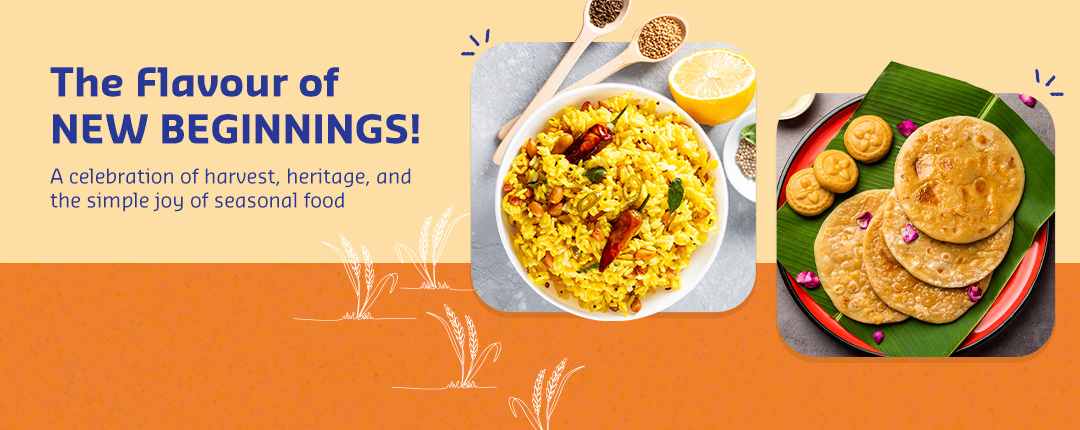
Taste of the Season: Celebrating India's Harvest Festivals
What is the fragrance of a new beginning for you?
In Maharashtra, it is the sharp sweetness of raw mango simmering into Ambyacha Panna. In Karnataka, it is the faint bitterness of neem flowers dissolving into jaggery in a cup of Bevu Bella.
Every harvest festival food in India answers this question differently, and every answer is worth savouring.
The Land Knows Best
Long before supply chains and centralised procurement existed, Indian kitchens followed one simple rule: cook what the season gives you. Gudi Padwa and Ugadi celebrate this principle as well. These festivals are not just new year celebrations; they are collective acts of gratitude to the soil, the rain, and the hands that tend to the harvest so the rest of us can gather around a table and enjoy the freshest flavours of the season.
At Sodexo, we believe festive menu planning in corporate India should honour this relationship. When ingredients are sourced locally and in season, the difference is immediate. The Kothimbir Wadi is crispier. The Masale Bhaat is more fragrant. The Avarekai Palya carries a depth of flavour that no imported substitute can replicate. Freshness is not a marketing claim; it is something you can taste in every bite.
From Farm to Fork and Beyond
The impact of meals curated around locally sourced, seasonal produce extends far beyond the plate. Farmers in the region get consistent, fair business, shorter transportation distances effectively reduce the carbon footprint of every plate served, and freshly harvested ingredients produce more nutrient-rich meals and create a stronger regional connect, with menus that celebrate the unique culinary identities of our communities.
Sodexo's Farm to Fork programme gives this approach a defined structure. By sourcing directly from Farmer Producer Organisations, diversified suppliers, and women's Self-Help Groups, it cuts out the middleman entirely. Farmers earn 15 to 25 per cent above mandi rates, and the difference reaches every plate: the raw mangoes in your Mavinkai Chitranna, the coconut in the Udupi Sambar, and the Purnachi Poli on your Gudi Padwa menu all carry the freshness and authenticity of produce grown close to home.
Sustainability at Sodexo does not stop at the kitchen door. Sodexo's WasteWatch programme runs across 200+ sites in India, logging food waste in real time so that what is carefully grown and sourced is never carelessly discarded. In 2025 alone, it prevented 2.17 million kilograms of food waste - a 36 per cent reduction against baseline - equivalent to 4 million meals saved and 15,176 metric tonnes of CO₂ emissions avoided.
This precision runs through the entire sourcing chain too. From ERP-integrated procurement and demand forecasting that prevents over-ordering, to live agri-price benchmarking and tablet-based quality audits at every delivery, technology ensures that sourcing is planned and optimised to minimise waste and improve efficiency.
Food That Starts a Conversation
When a meal carries this much intention behind it, what gets shared around the table is more than just the food. A colleague from Karnataka discovering Shrikhand for the first time at a Gudi Padwa spread, or a Maharashtrian colleague experiencing the ritual significance of Bevu Bella during Ugadi—these are examples of brief cultural exchanges that carry great significance for an organisation’s work culture.
Traditional Indian festival foods don’t just feed people. They tell stories, spark curiosity, and create shared memories around the table.
This harvest season, let your workplace cafeteria reflect the richness of what India's land and its festivals have to offer. Partner with Sodexo and turn every meal into something worth celebrating.